How to Record Stories Remotely With Ease
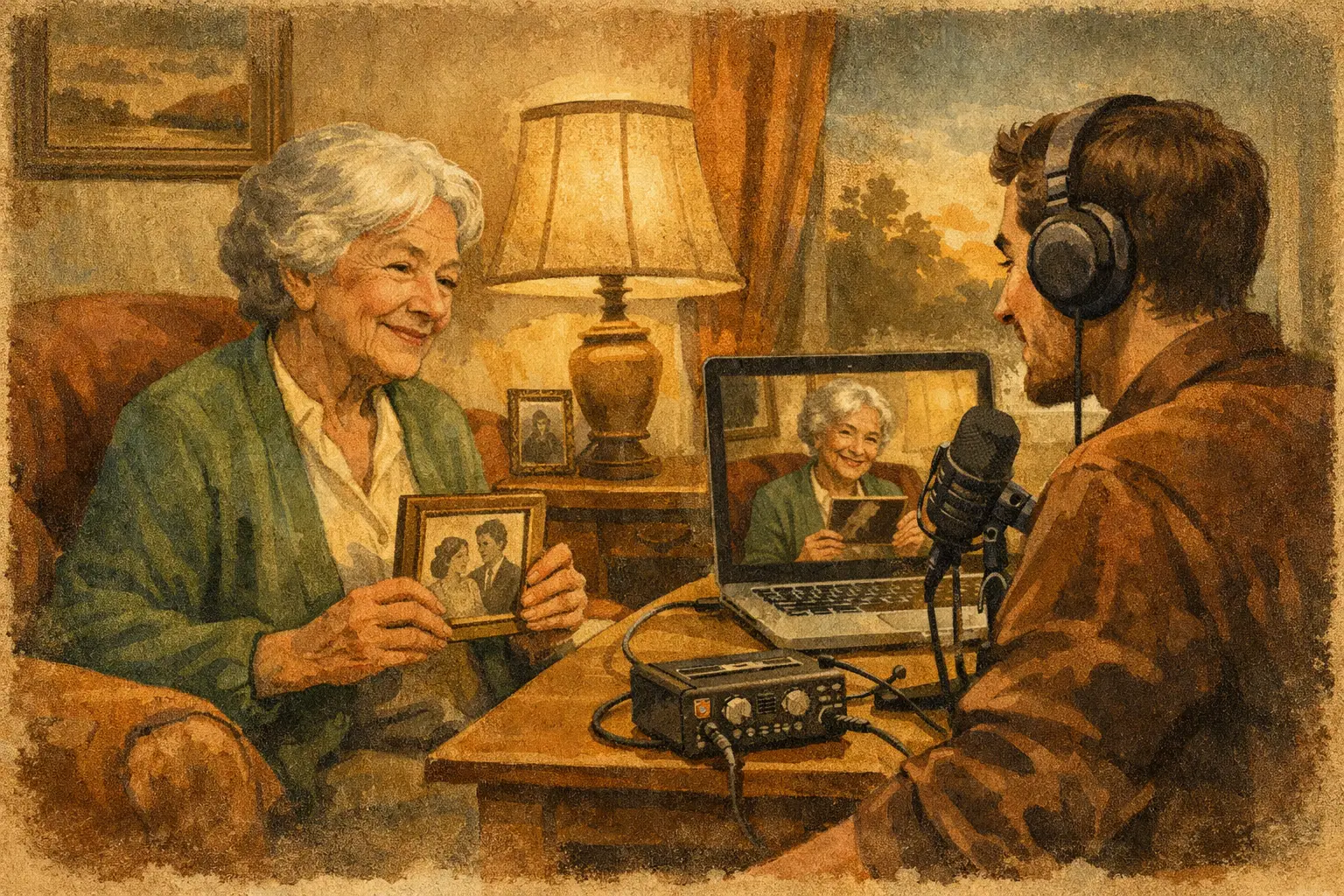
A missed chance often sounds small in the moment. You mean to call next weekend, to ask one more question, to have your dad tell that story about his first apartment again - and then life gets crowded. Learning how to record stories remotely gives families a way to hold onto the voice behind the memory, even when everyone lives in different places.
Why remote recording matters for families
Storytelling rarely happens on a perfect schedule. A parent may live in another state. A grandparent may feel most comfortable talking from home. Siblings may want to help, but coordinating one in-person gathering can take months. Remote recording solves a real problem: it lets you preserve someone’s voice while there is still time, without turning the process into a major production.
That matters because voice carries more than words. It holds laughter, pauses, phrasing, and personality. A written memory can tell you what happened. A recording lets you hear how it was lived.
For many families, remote recording also lowers emotional pressure. Sitting in a studio or setting up formal equipment can feel intimidating, especially for older relatives. A familiar phone call or browser-based recording session often feels more natural. People tend to open up when they are comfortable.
How to record stories remotely without making it complicated
The best approach is usually the simplest one your loved one will actually use. Families sometimes spend too much time comparing microphones, apps, and file formats when the real goal is to capture a voice clearly and calmly. If the process feels hard, it gets postponed. If it feels easy, stories start coming through.
Begin by choosing the recording method that matches your loved one’s comfort level. If they are confident with a laptop, a browser-based recorder may work well. If they prefer the phone and do not want to manage screens or logins, a phone-based option is often better. The right tool is the one that removes friction.
Audio quality matters, but perfection is not the standard. Clear enough is enough if the story is heartfelt and understandable. A quiet room, a stable device, and a little preparation usually make a bigger difference than expensive gear.
Pick the right setting, not just the right device
Before you record, help your loved one find a quiet place with soft furnishings if possible. A bedroom, den, or living room with curtains and carpet often sounds better than a kitchen with hard surfaces. Ask them to turn off the television, silence notifications, and sit comfortably with the phone or computer close enough to capture a natural speaking voice.
If they tire easily, keep sessions short. Fifteen to twenty minutes can be more productive than trying to record for an hour. You can always gather stories over several conversations.
Prepare prompts that invite real memories
The difference between a flat recording and a treasured one is often the question. "Tell me about your childhood" is so broad that it can leave someone unsure where to begin. "What did your home smell like when your mother was cooking?" gives them something to step into.
Good prompts are specific, gentle, and open-ended. Ask about first jobs, favorite holidays, neighborhoods, military service, courtship, parenting, family sayings, lessons learned, and the objects they kept for a reason. If someone is hesitant, start with stories they have told before. Familiar memories build confidence.
It also helps to ask for personal messages, not only life history. A birthday message for a grandchild, advice for future generations, or a few words about what mattered most in life can become the part a family returns to again and again.
A simple process for recording stories from different locations
When families ask how to record stories remotely, what they usually want is a process they can trust. It does not need to be elaborate. It just needs to be thoughtful.
Start by scheduling the conversation at a time when your loved one has energy. Morning may be best for some people, while others are more relaxed in the afternoon. Let them know ahead of time that this is not a test and there are no wrong answers. That reassurance helps more than you might think.
Then send a short list of topics in advance. Some people speak beautifully off the cuff. Others need a little time to remember names, dates, or details. A preview can help them feel prepared without making the session feel scripted.
During the recording, let silence do some work. If a story stirs emotion, do not rush to fill the pause. Those small moments often carry the deepest meaning. At the same time, be ready to guide gently if they lose their place. A simple follow-up like "What happened next?" or "How did that feel at the time?" keeps things moving without interrupting the memory.
Afterward, save and organize the file right away. Give it a clear name such as "Grandma Helen - Meeting Grandpa - March 2026." Families are often surprised by how quickly recordings pile up. A good naming system prevents future confusion and makes it easier for others to listen later.
When one interviewer is not enough
Sometimes the best remote story sessions involve more than one family member. One sibling may know the military history, another may remember the family recipes, and a grandchild may ask questions no adult would think to ask. Shared participation can bring out richer stories.
Still, too many voices in one session can feel overwhelming. If several relatives want to help, consider assigning themes across separate recordings. One call can focus on childhood, another on marriage and family, and another on values, advice, or personal messages. This keeps each conversation calm and clear.
Common challenges and how to handle them
Remote recording is simple, but it is not always effortless. The most common issue is not technology. It is emotion.
A loved one may say they do not know what is worth recording. They may worry they are rambling. They may feel self-conscious hearing their own voice. The best response is gentle honesty: what feels ordinary to them may become precious to the people who love them. A memory does not need to be historically important to be deeply valuable.
Another challenge is inconsistency. Some relatives are eager one day and resistant the next, especially if they are dealing with illness, grief, or fatigue. In those cases, flexibility matters. Record shorter clips. Follow their pace. A meaningful legacy can be built in small pieces.
There is also the practical question of permanence. Families do not just want to know how to record stories remotely. They want to know the recordings will still be there years from now, organized and accessible. That is why storage and long-term preservation matter as much as the recording itself. If files end up scattered across phones, email threads, and old laptops, the emotional value can be lost in the mess.
For that reason, many families prefer a single place where recordings, stories, and messages can be stored, organized, and shared across generations. VoiceForEternity was built around that need, with a focus on preserving the human voice as the heart of remembrance.
What makes a remote story worth keeping
The most meaningful recordings are rarely the most polished. They are the ones that sound real. A laugh in the middle of a sentence. A pause before naming someone dearly loved. A detail no one else remembered. These are the moments that turn an audio file into a family treasure.
It helps to think beyond biography. Record the story of a wedding day, but also the lesson learned from a hard year. Record family history, but also how your loved one wants to be remembered. Record the funny memory, the recipe explanation, the advice for new parents, the apology, the blessing, the ordinary greeting. A full life is made of all of it.
If you are wondering whether now is the right time, it probably is. You do not need to wait for a formal occasion, a milestone birthday, or a decline in health to begin. One conversation is enough to start. Often, once the first story is captured, the next one comes much more easily.
Their voice does not have to be perfect. It just has to be theirs. Start with one question, one quiet moment, and one recording your family will be grateful to hear again.