How to Organize Inherited Stories with Care
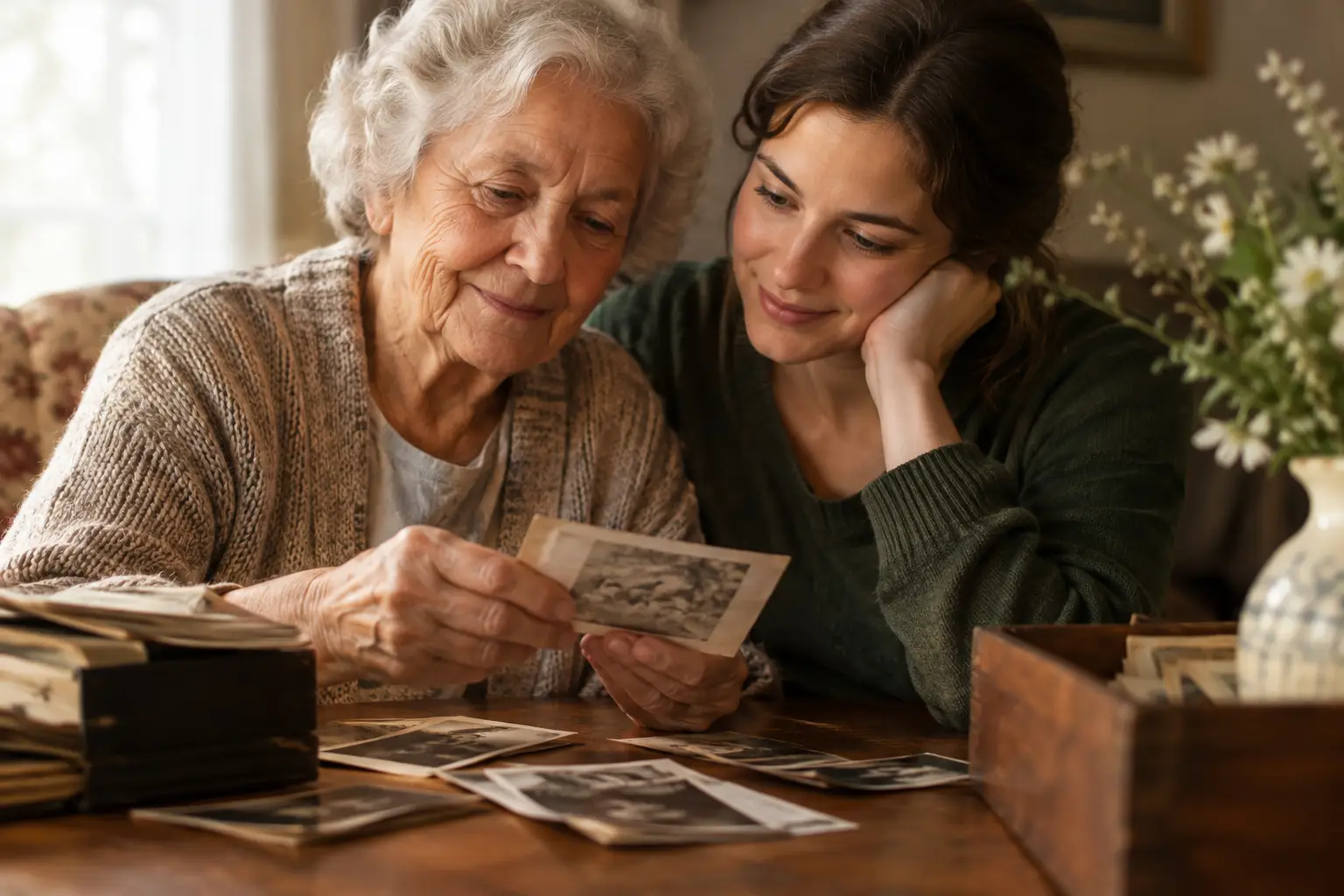
Inherited stories rarely arrive in order. They come in a box of labeled photographs, a voicemail saved on an old phone, a recipe written in the margin of a church cookbook, and a sentence someone repeats at the funeral: “He always said…” Learning how to organize inherited stories is not about making a family history look perfect. It is about protecting the details that make someone feel real to the people who come after you.
The work can feel tender, especially after a loss. Start small, make room for differing memories, and focus first on preserving what cannot be replaced. A clear system can bring calm to the process while honoring the person at the center of it.
Start by gathering without judging
Before sorting, collect what your family has. Ask relatives to look through their homes, phones, email folders, and social media accounts for voice recordings, letters, home videos, photographs, journals, recipes, and saved messages. A cousin may have the only recording of your grandmother laughing. An old neighbor may remember the story behind a photograph no one else can identify.
At this stage, resist the urge to decide what is valuable. A blurry photo may matter because it captures a beloved kitchen. A three-second voicemail may become the recording a family returns to most. Create one temporary place for everything, whether that is a labeled storage box, a shared digital folder, or both.
If several people are involved, let each person contribute in the way that feels manageable. One family member may scan documents, another may identify people in photos, and another may be most comfortable recording spoken memories. You do not need one person to carry the whole responsibility.
How to organize inherited stories around people and moments
The simplest organizing method is usually a combination of person, time, and theme. Rather than placing every item into one large category called “Family History,” give each memory enough context that someone unfamiliar with it can understand why it matters.
Begin with a few broad sections: the person’s early life, family and relationships, work or service, traditions and beliefs, favorite stories, and messages for loved ones. Then add moments that naturally belong beneath those sections, such as “the move to Ohio,” “Sunday dinners,” “the fishing cabin,” or “how Mom and Dad met.”
A story does not always need an exact date. If no one knows the year, use an honest description such as “early 1970s,” “before the family moved,” or “when the children were young.” Guessing can create confusion later. A little uncertainty, clearly stated, is more respectful than false precision.
For every item, add a short note answering three questions: Who is involved? What is happening? Why should this be remembered? That note may be only one or two sentences, but it turns an unlabeled object into a memory that can travel across generations.
Keep the storyteller’s words intact
When you transcribe a letter or summarize an audio recording, preserve the original alongside the edited version whenever possible. A polished paragraph is helpful for searching and sharing, but a person’s phrasing, pauses, humor, and accent often carry the deepest meaning.
This is especially true for voice recordings. The sound of a loved one saying a nickname, telling a familiar story, or offering encouragement cannot be fully captured in text. Save the original file in a clearly labeled place and make a backup before editing, trimming, or sharing it.
Create a simple naming system
A consistent name makes memories easier to find when emotions are high. Choose a format your family can understand at a glance, such as: year or estimated era, person’s name, type of memory, and a brief description.
For example: “1985_AnnaGarcia_Audio_FirstDayTeaching” or “1960s_RobertLee_Photo_FamilyGarden.” If the date is unknown, use “Undated” rather than leaving the file unnamed. For physical items, use matching labels on folders, envelopes, or archival boxes.
Do not overbuild the system. A complicated set of codes may work for a professional archive, but family members need something they can continue using. The best organization method is one that survives beyond the person who created it.
Record the memories that only live in people’s minds
Some of the most meaningful inherited stories have never been written down. They live with the aunt who remembers every holiday, the longtime friend who knew your father before he became a parent, or the spouse who can explain why a certain song mattered.
Set aside time for short conversations rather than formal interviews if that feels easier. Ask specific, gentle questions: What was she like when she was young? What did he do that made people laugh? What did their home smell or sound like? What family lesson did they repeat? Specific questions often invite richer answers than “Tell me everything.”
Record these conversations with permission, even if you also take notes. Voices preserve tenderness, personality, and spontaneous details that can disappear in a written summary. If someone does not want to be recorded, honor that boundary and write down what they are willing to share.
Make room for more than one version of a story
Families do not remember the past in exactly the same way. One sibling may remember a parent as strict, while another remembers the same parent as protective. Both memories can be true expressions of a relationship.
Avoid trying to force a single official version of every event. Instead, label the source: “Maria remembers,” “According to Uncle James,” or “From a letter written in 1994.” This protects the integrity of the archive and leaves space for complexity.
If a story includes painful family history, decide together what should be shared widely and what should remain private. Organizing inherited stories is not the same as publishing every detail. Families deserve both honesty and discretion.
Preserve the collection in more than one place
A well-organized collection still needs protection. Keep original physical materials in a dry, stable location away from direct sunlight, and avoid taping, laminating, or writing directly on irreplaceable photographs and letters. Scan important documents and photographs at a quality suitable for future printing.
For digital memories, keep copies in at least two separate places. One may be an external drive stored safely at home, while another can be a trusted long-term digital archive. Review the collection occasionally to make sure files still open and that the people who need access know where to find them.
For families who want a more personal way to share recordings, a permanent memorial page can bring stories, messages, and a loved one’s voice together in one place. VoiceForEternity can help families create a QR-linked listening experience that connects a physical memorial with the stories behind it.
Choose what to share now
You do not have to wait until the collection is finished to let it bring comfort. Share one recording at an anniversary gathering, print a favorite story for a birthday, or invite relatives to add a memory during the holidays. Small acts of sharing keep the archive alive rather than turning it into a box no one opens.
Consider making a brief “start here” collection for children and future family members. Include a few photographs, a family tree if available, several signature stories, and at least one recording that lets them hear the person’s voice. The goal is not completeness. It is connection.
The stories you inherit are not only evidence of the past. They are a way for someone’s humor, courage, faith, and ordinary kindness to remain present. Give them names, give them context, and let the people who matter hear them again.