Memorial Plaque With QR Code: What to Know
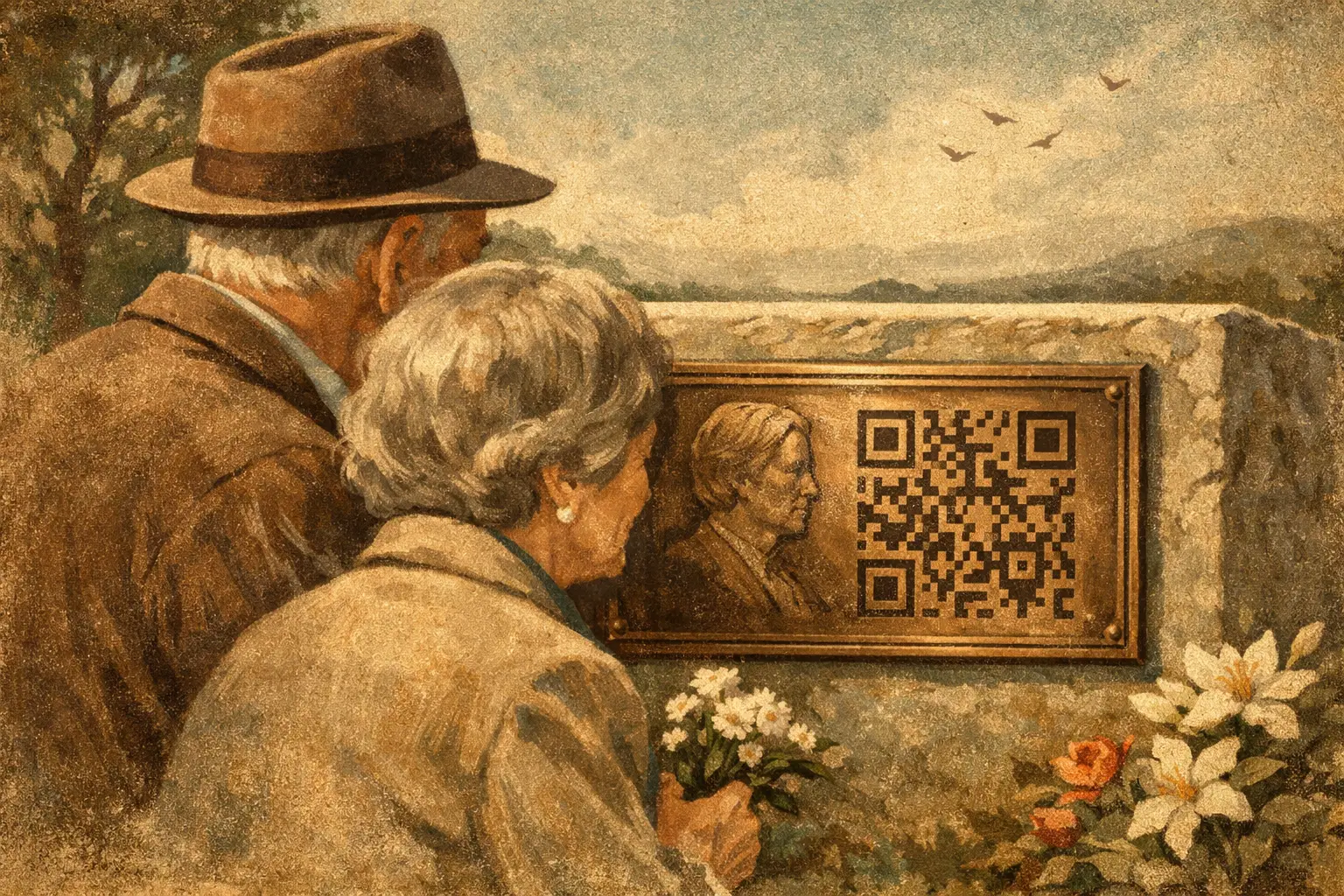
Some families stand at a grave, a garden stone, or a niche and feel that the name and dates are true, but incomplete. A memorial plaque with qr code changes that experience. It gives loved ones a way to hear a familiar voice, revisit a life story, and share memories that would never fit on metal or stone alone.
That shift matters because grief is not only about facts. It is about presence. A plaque can mark a place with dignity, but a QR-linked memorial can also carry the laugh, the accent, the pauses, the phrases a person always said, and the stories future generations would otherwise never know. For many families, that is the difference between a marker and a living remembrance.
What a memorial plaque with qr code actually does
At its simplest, the plaque holds a scannable code engraved or printed into a durable surface. When someone scans it with a phone, they are taken to a memorial page. That page may include an obituary, photos, written memories, and dates, but the most meaningful versions go further. They let visitors hear the person speak, listen to stories in their own voice, or receive messages recorded for children, grandchildren, or a spouse.
That is where the idea becomes more than a technology feature. Voice carries identity in a way text cannot. A sentence typed on a page can be moving. The same sentence spoken by the person you miss can stop you in your tracks.
For families who worry that digital memorials can feel cold or complicated, the reality is often the opposite. A QR plaque can be one of the most human forms of remembrance because it turns a quiet visit into a moment of connection.
Why families are choosing this kind of memorial
A traditional plaque still has an important place. It is lasting, visible, and respectful. But many families now want more than a static inscription, especially when relatives live far apart or younger generations never had the chance to know the person well.
A memorial plaque with qr code helps bridge those gaps. A daughter can visit a cemetery and hear her father tell the story he always told at Thanksgiving. A grandchild can scan a plaque years later and listen to a grandmother say their name. A friend across the country can participate in remembrance without needing to travel on a specific date.
This format also creates room for a fuller life story. Most plaques have obvious space limits. Even a beautifully written inscription must be brief. A QR-linked page can hold audio, photo collections, milestone memories, family contributions, and updates over time. The physical marker remains simple and dignified while the memorial itself becomes far more personal.
There is also a practical reason people are drawn to it. Families often feel pressure to gather stories quickly after a loss, when emotions are high and details are hard to organize. A digital memorial tied to a plaque gives them a place to build gradually, with less pressure to get everything perfect at once.
What to look for before you choose one
Not every QR memorial setup is created with the same level of care. The plaque itself matters, of course, but so does the memorial system behind it.
Durability should be one of the first questions. If the plaque will be placed outdoors on a headstone, garden memorial, bench, or niche, the material needs to hold up to weather, sunlight, and regular exposure. Engraving quality matters too. If the code is poorly produced, scanning can become frustrating over time.
Just as important is what happens after the scan. Some memorial pages focus mostly on text and photos. That may be enough for some families. But if preserving personality is the goal, audio recording and playback make a real difference. The ability to capture stories by phone or browser can be especially helpful when family members are in different locations or when an older loved one is more comfortable speaking than typing.
Ownership and permanence deserve careful attention as well. Families are right to ask what happens years from now. Will the memorial still be accessible? Is it tied to a recurring payment? Can multiple family members contribute? A remembrance product should reduce anxiety, not create more of it.
There is also the question of privacy. Some families want a public memorial page. Others prefer something shared only with relatives and close friends. A good solution should respect both needs.
The emotional difference between reading and listening
Most people understand the value of photos. They freeze a face in time. But voices preserve something subtler and, for many, more powerful. A voice carries tenderness, humor, confidence, age, and history all at once.
That is why audio-centered memorials resonate so deeply. They do not only tell you who someone was. They let you experience a part of them again.
This can be especially meaningful for children and future generations. A written memory can say, "He was kind" or "She always sang in the kitchen." Hearing that kindness or that singing for yourself creates a different kind of inheritance. It becomes less like reading family history and more like meeting the person.
For families planning ahead, this is often the moment the idea clicks. They realize they are not simply choosing a memorial format. They are preserving a relationship in a form that can still be felt.
When a QR memorial is the right fit - and when it may not be
A memorial plaque with qr code is a beautiful option, but it is not automatically right for every setting. Some cemeteries or memorial parks have specific rules about attached items, plaque sizes, or technology-based additions. It is wise to confirm those requirements before ordering anything intended for a grave marker or niche.
It also depends on the family’s preferences. Some people want a memorial experience that stays fully traditional and physical. Others are immediately drawn to the idea of adding stories, voice recordings, and family memories. Neither instinct is wrong. The right choice is the one that feels respectful to the person being honored and comforting to the people who will return to remember them.
There can be generational concerns too. A family may worry that older relatives will not use QR codes. In practice, that matters less than people think because the code is only one way into the memorial. Once younger relatives help set it up, the page and recordings can still be shared more broadly. The physical plaque remains meaningful on its own, while the digital layer adds depth for those who want it.
How families often use these plaques
The most common setting is a cemetery marker, but that is far from the only one. Families also place QR memorial plaques near cremation urns, in memorial gardens, on benches, or in columbarium niches. Some keep a plaque at home as part of a remembrance table, especially when they want a private place to revisit messages and stories.
In pre-planning situations, the plaque can become part of a larger legacy project. A parent or grandparent records memories, answers guided questions, leaves messages for future milestones, and helps shape the memorial page in their own words. Later, the plaque becomes the physical invitation to hear that preserved voice.
This is one reason the model feels so comforting to many families. It can support remembrance after loss, but it can also make room for love, intention, and storytelling before loss.
Choosing a memorial that feels worthy of the person
The best memorials do two things at once. They create a lasting physical marker, and they reflect the person in a way that feels unmistakably theirs. A plaque alone can do part of that work. A digital page alone can do another part. Together, they can create something fuller.
For families who want more than a name and dates, the most meaningful choice is often the one that preserves the sound of a life as well as the record of it. That is what makes solutions like VoiceForEternity feel so different. The focus is not just on storing information. It is on keeping a voice, a story, and a sense of presence available for the people who need it most.
A memorial does not have to say everything in one small line of text. Sometimes its quietest role is simply to open the door to hearing them again.